English
 German
 French
 Russian
 Spanish
 Japanese
 Korean
 Portuguese
 Ukrainian
 Arabic
 Italian

How to Identify High-Quality Compatible Parts for Construction Machinery
Keeping your construction machinery in peak working condition is essential for productivity, safety, and cost control. For many owners and fleet managers, compatible aftermarket parts have become a smart alternative to expensive OEM components. The challenge is knowing how to distinguish truly high-quality compatible parts from low-cost, low‑reliability options.
Based on the solutions and strengths highlighted on ACM Part, this guide explains how to identify high‑quality compatible parts for construction machinery and what to focus on when choosing your supplier.
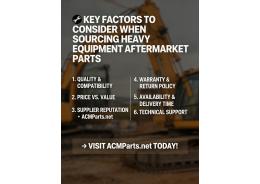
1. Understand What “Compatible Parts” Really Mean
Compatible parts (also called replacement parts or aftermarket parts) are components that are not made by the original machine manufacturer but are designed to fit and perform like the OEM part. High‑quality compatible parts will:
- Match the OEM’s critical dimensions, interfaces, and mounting positions
- Use equal or better material specifications
- Deliver comparable performance, durability, and reliability
- Integrate seamlessly into your existing systems without modification
Brands like ACM focus on compatible construction machinery parts, offering alternatives for earthmoving, road building, and other heavy-duty equipment while controlling cost and lead time.
2. Check the Supplier’s Specialization and Industry Focus
High‑quality parts usually come from suppliers that specialize in a clear segment rather than trying to do everything for everyone. When evaluating a compatible parts provider, look for:
- Focused product categories – e.g., undercarriage, ground engaging tools, engine parts, hydraulic components, or electric/electronic systems for construction machinery.
- Industry experience – years of supplying construction machinery components, not just general industrial hardware.
- Application knowledge – ability to recommend parts based on machine model, working environment, and duty cycle.
On its website, ACM positions itself clearly around construction machinery compatible parts, signaling a deep understanding of heavy equipment applications rather than generic mechanical components.
3. Evaluate Quality Control and Manufacturing Standards
The core difference between low‑grade and high‑grade compatible parts lies in manufacturing and quality control. Indicators of strong quality management include:
- Certified quality systems – such as ISO 9001 or equivalent quality management frameworks.
- Material traceability – clear records of materials, heat treatment, and production batches.
- Incoming and outgoing inspection – dimensional checks, hardness and strength testing, pressure and leak tests for hydraulic components, etc.
- Process control – use of CNC machining, controlled welding procedures, surface treatments, and consistent assembly processes.
Reputable suppliers describe their quality process and show how they control each stage from design to packaging. Before choosing a vendor, request details about their testing standards and inspection routines.
4. Confirm Fitment and Technical Compatibility
Even if the price is attractive, a part that doesn’t fit or perform as required will cost you more in downtime and rework. To verify compatibility:
- Use the correct part number – provide the OEM part number and machine model to your supplier so they can cross-reference the compatible equivalent.
- Compare technical specs – working pressure, load rating, dimensions, material grade, and any electrical or hydraulic interfaces.
- Ask for drawings or data sheets – serious suppliers can share dimensional drawings or spec sheets for confirmation.
- Check installation requirements – ensure no extra modifications or adapters are needed unless clearly explained and accepted.
Suppliers like ACM typically maintain a structured product catalog by machine brand and model, making it easier to select the correct compatible components with confidence.
5. Look at Material Selection and Production Technology
Construction machinery works in extreme conditions: heavy loads, impact, abrasion, dust, moisture, and temperature changes. High‑quality compatible parts must start with the right material and processing. Points to check include:
- Material grade and certification – for example high‑strength low‑alloy steels, wear‑resistant steels, heat‑resistant alloys, or high‑performance seals.
- Heat treatment – proper quenching and tempering to achieve the required hardness and toughness.
- Surface treatment – plating, painting, nitriding, or other treatments to improve corrosion and wear resistance.
- Precision machining – tight tolerances ensure correct fit, reduce vibration, and protect mating components.
Quality-focused compatible part manufacturers invest in modern machining centers, casting and forging technology, and controlled heat-treatment lines to closely match or exceed OEM standards.
6. Assess Product Range and Solution Capability
High‑quality suppliers are not only selling single parts; they provide complete solutions around construction machinery maintenance and repair. This is where providers like ACM differentiate themselves: they position as a compatible parts solution partner rather than just a parts trader.
Consider:
- Coverage of key systems – engine, transmission, hydraulic system, chassis, cab, and attachments.
- System-level understanding – the ability to recommend related parts that should be replaced together to avoid premature failures.
- Customized or OEM‑equivalent kits – such as seal kits, filter kits, or overhaul kits that match specific machine models.
A supplier with a broad yet focused catalog can help you reduce sourcing complexity, consolidate shipments, and maintain more consistent quality across your fleet.
7. Check Logistics, Delivery Capability, and Packaging
Construction projects run on tight schedules; parts that arrive late or damaged can stop an entire site. Reliable compatible parts suppliers invest in logistics and packaging, not just production. Evaluate:
- Inventory and stock strategy – does the supplier keep common parts in stock to shorten lead times?
- Global shipping experience – experience with export documents, customs, and safe packaging for long-distance transport.
- Protective packaging – anti-rust coatings, shock‑absorbing materials, clear labels, and part identification.
Providers like ACM emphasize stable supply and efficient transport as part of their value proposition, which helps minimize downtime and uncertainty for international buyers.
8. Review Service, Technical Support, and Communication
High‑quality compatible parts go hand in hand with professional service. Before placing major orders, test the supplier’s responsiveness and expertise:
- Pre‑sales consultation – can they quickly help you identify parts and provide alternatives when the OEM number is unclear?
- Technical support – access to engineers or technical staff who understand construction machinery and can discuss failure modes, material choices, and product selection.
- After‑sales service – clear policies on handling quality issues, incorrect shipments, or warranty claims.
- Communication speed and clarity – fast, professional replies signal that they can also respond quickly when issues arise.
Suppliers that position themselves as long‑term partners—such as ACM—tend to invest more in these service elements, which directly translates to smoother maintenance operations for your machines.
9. Compare Cost vs. Lifecycle Value
Price is one of the main reasons to choose compatible parts, but focusing only on unit cost is misleading. Instead, look at lifecycle value:
- Service life – how long does the part actually last in your real working conditions?
- Failure risk – a cheap part that fails early can damage other expensive components and cause long downtime.
- Total cost per operating hour – combine part price, installation cost, and expected lifespan.
High‑quality compatible parts from specialized suppliers typically cost less than OEM parts but are designed to deliver comparable working life, giving you a better cost‑to‑performance ratio over the equipment’s lifetime.
10. Use a Structured Evaluation Checklist
To consistently identify high‑quality compatible parts for construction machinery, create a simple evaluation checklist you apply to all potential suppliers:
- Industry focus on construction machinery
- Quality certifications and testing standards
- Proven compatibility with your machine brands and models
- Material and process transparency
- Range of products and solution capability
- Logistics reliability and packaging quality
- Technical support and after‑sales service
- Customer references or case studies
- Balanced pricing vs. expected service life
Using this framework, you can compare suppliers side by side and quickly identify partners—like ACM—that are set up to deliver reliable compatible parts for demanding construction environments.
Conclusion
High‑quality compatible parts are a powerful way to keep construction machinery running efficiently while controlling maintenance costs. By focusing on supplier specialization, quality control, technical compatibility, materials and production, logistics, and support, you can dramatically reduce the risk of poor‑quality components.
Platforms such as ACM Part demonstrate how a dedicated compatible parts provider can combine engineering know‑how, rigorous manufacturing, and reliable supply to help contractors and fleet managers build a stable, cost‑effective parts strategy.